
Mansura
Issak Esmail Issak (author) · Mohamed Ahmed Saleh (preface)
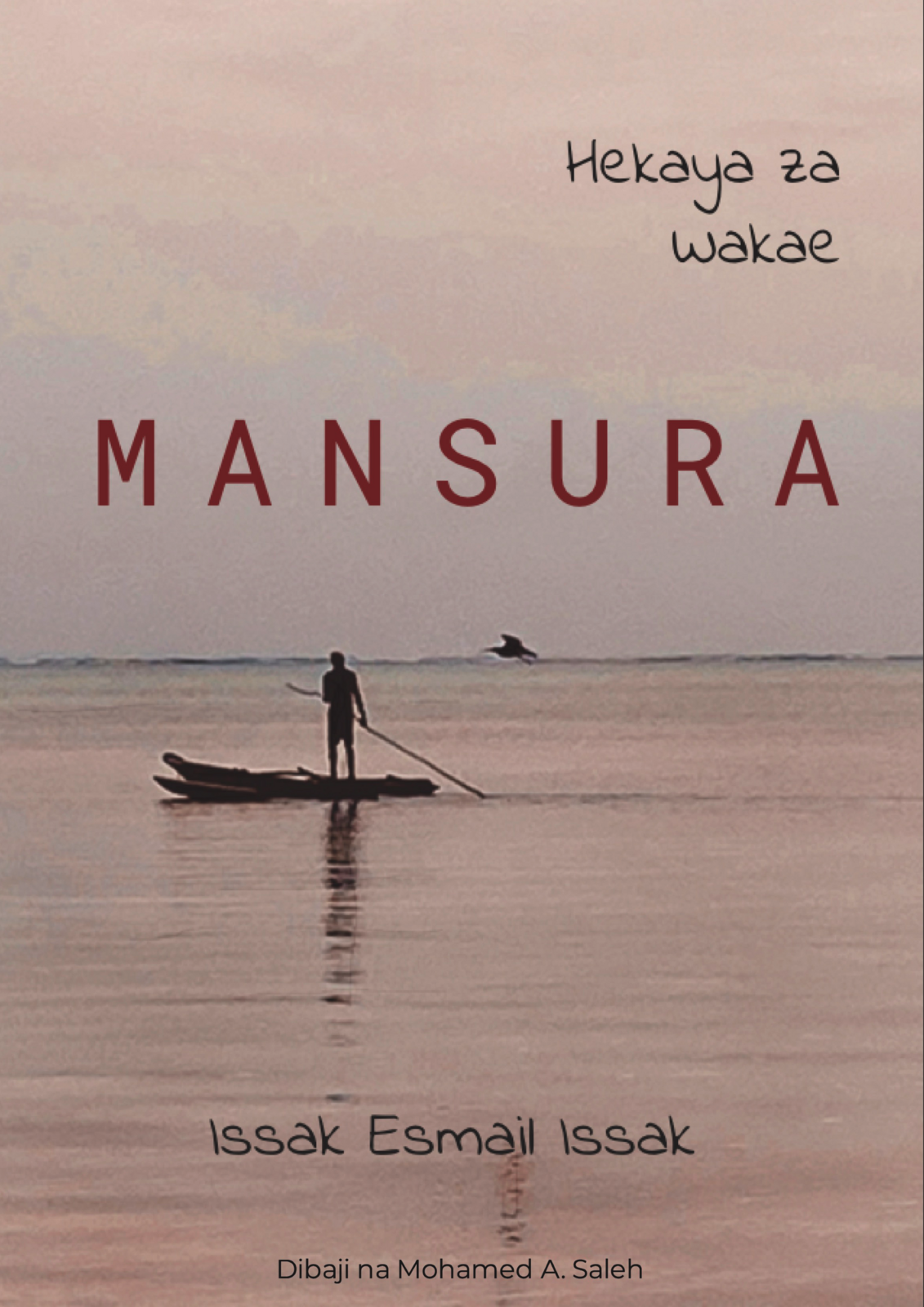
Mansura ni mwaliko wa safari ya kuelekea katika Hekaya za Wakae, wakaazi wa nchi ya dongo jekundu, iliyopo kusini mwa kisiwa cha Unguja, ambako ulikuwa ukiweza kufika kwa kupanda gari nambari 10.
Ni usanifu wa ulimwengu uliojengeka katika fikra na mawazo yaliyosarifiwa kwa ustadi mkubwa na kumwingiza msomaji katika jahazi la msafara mrefu unaompeleka katika Bahari ya Hindi, yenye mikondo inayopanda na kushuka, na kuakisi maisha ya Wakae. Kwa mchanganyiko wa Kiswahili fasaha na Kikae, mwandishi anafungua milango ya kuifahamu misingi na mitazamo ya kimaisha, mila, utamaduni na itikadi za kusini mwa kisiwa cha Unguja. Hekaya za Wakae zinambeba msomaji kitikiti, kumpandisha na kumshusha, kumpeleka mbele na kumrudisha nyuma katika dahari mbalimbali za maisha zilizoacha chapa katika visiwa vya karafuu. Kwa ustadi mkubwa mwandishi anampaaisha na kumrudisha chini msomaji wake, huku saa yake ikenda mbele na kurudi nyuma, kwa usafiri wa baskeli, gari la punda na gari la matwana, pamoja na vyombo vyengine vinavyoonekana na visivyoonekana. Kama smaku mwandishi anamvuta na kumgandisha msomaji katika tafakuri kubwa inayomkumbanisha na viumbe vya kila aina, vile vyenye maumbo ya kuvutia na vile vyenye maumbo ya kutisha, vile vinavyoishi hewani, na vinavyoishi ardhini na baharini.
Kwa falsafa na mantiki kubwa, mwandishi anajaribu kwa kiwango cha uwezo wake kuweka kumbukumbu za mifumo ya kimaisha, vipaji na makarama ya wakaazi wa sehemu za kusini Unguja, ambazo taratibu zinapotea. Issak yuko hadhir kabisa juu ya athari ghasi za kutoka nje juu ya mifumo ya maisha na ustawi wa jamii ya Wazanzibari.
Mansura ni jitihada za mwandishi katika harakati za kuokoa japo chembe yale muhimu aliyoyajua kwa kuyaishi na kuyasikia, yaliyojenga mustakabali wa maisha yake yeye mwenyewe na jamii yake ya Wakae. Jamii ambayo imetoa mchango mkubwa katika historia ya nchi. Kwa jumla, hisia, njozi, imani za kidini na kidunia, mazingira na mazingara yaliyofafanuliwa katika kitabu hichi yanayowakilisha Wakae, yana taathira na kuakisi pia kwa kiasi kikubwa maisha ya jamii mbali mbali za visiwani na utambulisho wa Zanzibar na Waswahili kwa jumla.
The work entitled Mansura, authored by Issak Esmail Issak, presents itself as a vast literary and memorial epic spanning over five hundred pages. It invites the reader to delve into the heart of the narratives, myths, and legends of the Wakae—the inhabitants of the red lands in the south of Unguja Island, Zanzibar. Through a metaphorical and temporal voyage navigating the Indian Ocean, the author weaves a dense narrative universe where the visible and invisible worlds converge, populated by celestial, terrestrial, and marine creatures. In the face of the continuous erosion of traditional ways of life under the pressure of external influences, this text constitutes a meticulous effort of memorial preservation. It documents, with profound philosophical depth, the customs, both religious and secular beliefs, talents, miracles, and the cosmology of an island community that has significantly contributed to the Swahili history and identity of the region.
The singularity of this document lies primarily in its exceptional linguistic dimension. The text is distinguished by a hybrid and skilfully articulated use of classical Zanzibari Swahili, known as Kiswahili fasaha, and Kikae. Kikae is the historical variant spoken specifically by the populations of southern Unguja, particularly in the Makunduchi region. Far from being a mere stylistic ornament, the employment of Kikae, coupled with Kiswahili fasaha, serves as the authentic key to accessing the concepts, poetry, and worldview specific to this region. This dual linguistic anchoring allows for the restoration, within a holistic perspective, of the terrestrial, maritime, and cosmological realities of the Wakae with a precision and expressiveness that uniformisation would inevitably have effaced.
Owing to its richness and scale, this volume represents a pre-eminent resource for both academic research and discerning readers. For the latter, the work offers a striking, dreamlike immersion, carried by a narration that multiplies temporal shifts and appropriates the aesthetics of traditional folktales. On a scientific level, it provides linguists with a massive and particularly rare textual corpus, enabling the study of the syntax, lexicon, and pragmatics of Kikae in a literary context at a time when many languages tend to fade away. For their part, anthropologists and ethnographers will find therein a living archive, precisely indexing the social systems, rituals, and the singular conception of space and time in southern Unguja. Finally, for historians and scholars, this work constitutes a precious endogenous testimony to the society of Kae and the impact of societal mutations, acutely documenting the cultural transition of the Zanzibari people and serving as the author's clarion call in the face of the ravages of modernity.
 MansuraOrder the paperback, printed on demand and shipped worldwide.lulu.com
 MansuraRead a free preview on Google Books.books.google.fr